
Super Visa Canada: Income Requirements, Eligibility & Latest IRCC Updates

Last Updated: March 2026 (Based on latest IRCC policy changes)
If you’re looking to bring your parents or grandparents to Canada, the Super Visa remains one of the most powerful and practical options available.
But here’s what most people don’t realize: Meeting the requirements is only half the battle. How you present your application determines the outcome.
With recent updates from Immigration, Refugees and Citizenship Canada (IRCC), the program is now more flexible but also requires more strategic planning.
This guide covers everything you need to know.
What Is the Super Visa?
The Parent and Grandparent Super Visa is a long-term, multiple-entry visa that allows eligible applicants to:
Stay in Canada for up to 5 years per visit
Enter Canada multiple times for up to 10 years
It is designed to support family reunification, especially for those who may not be able to access permanent residence sponsorship immediately.
Latest IRCC Update: Changes to Income Requirements (March 2026)
In a major policy update announced on March 20, 2026, IRCC introduced new ways for families to meet the Super Visa income requirement. These changes will take effect on March 31, 2026.
What Changed?
1. Two-Year Income Assessment
Instead of relying only on your most recent tax year, you can now qualify using:
Either of the last two taxation years
This benefits individuals with:
Variable income
Business income fluctuations
Temporary financial changes
2. Combined Income Option
For the first time, IRCC now allows:
The host’s income + co-signer (if applicable)
Plus the visiting parent or grandparent’s income
This creates a new pathway for families who were previously just below the income threshold.
Who This Applies To
New applications submitted after March 31, 2026
Applications already in processing
If your application is in progress, you may already benefit from these changes.
Super Visa Income Requirements (LICO Table)
To qualify, the host must meet the Minimum Necessary Income (LICO + 30%), based on total family size.
Income Requirement Table
Family Size | Minimum Income Required |
1 person | $30,526 |
2 persons | $38,002 |
3 persons | $46,720 |
4 persons | $56,724 |
5 persons | $64,336 |
6 persons | $72,560 |
7 persons | $80,784 |
Each additional person | + $8,224 |
Family size includes:
The host
Spouse/co-signer
Dependents
Visiting parent(s)/grandparent(s)
How to Meet the Income Requirement Strategically
With the new rules, you now have multiple options:
Use your strongest tax year
Add a co-signer (spouse or partner)
Include parent’s income (pension, business, investments)
This flexibility is powerful but only if used correctly.
Super Visa Host Requirements
The host (child or grandchild in Canada) must:
Be a Canadian citizen, permanent resident, or Registered Indian
Be at least 18 years old
Live in Canada
Meet the minimum income requirement
Provide a signed invitation letter confirming financial support
Super Visa Applicant Requirements
The parent or grandparent must:
Apply from outside Canada
Be admissible to Canada
Complete an immigration medical exam
Demonstrate temporary intent (will leave Canada after stay)
Provide required supporting documents
Mandatory Medical Insurance Requirement
This is one of the most critical parts of the application.
The applicant must have private health insurance that:
Is valid for at least 1 year
Covers:
Health care
Hospitalization
Repatriation
Is issued by a Canadian or approved foreign insurer
Many applications are refused simply because the insurance does not meet IRCC standards.
How IRCC Assesses Your Application (Beyond Eligibility)
Even if you meet all the requirements, IRCC will still assess:
Your ties to your home country
Your purpose of visit
Your financial situation
Your likelihood of leaving Canada after your stay
This is where many applications fail—not on eligibility, but on credibility and presentation.
Real Super Visa Success Stories

Case Study #1: First Time Supervisa Application Approved
Challenge: Refused US and Uk Visa and had no close family ties to Nigeria
Strategy: Ensured income requirements were met & Strong ties to home country were shown
Result: Approved in 2 weeks
Case Study #2: Approval using income of Son-inlaw
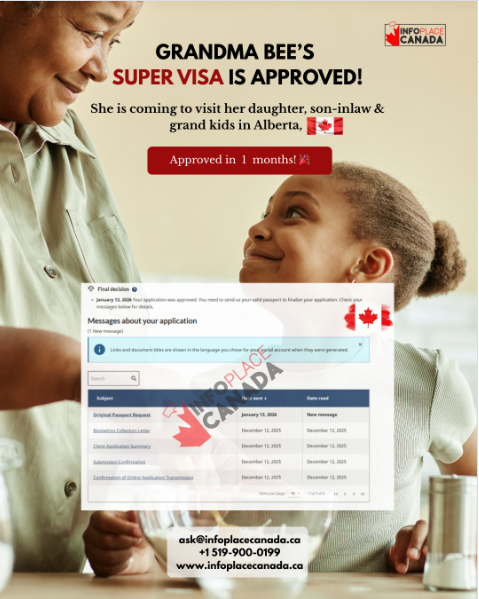
Challenge: Stable sufficient funds to support the visit despite meeting the LICO requirements
Strategy: Had enough document to support source of funds
Result: Approved in 1 Month
Key takeaway: Eligibility opens the door, but strategy determines approval.
Common Reasons Super Visa Applications Are Refused
Even with the new flexibility, refusals still happen due to:
Incorrect income calculations
Missing or weak financial documentation
Poorly written invitation letters
Weak proof of ties to home country
Failure to demonstrate temporary intent
IRCC is not just verifying documents they are assessing risk.
Super Visa vs Visitor Visa: Which One Is Right for You?
Not everyone needs a Super Visa.
Choose a Super Visa if:
You want long stays (up to 5 years)
You meet income requirements
You want long-term family visits
Your are a parent or grand parent to a Canadian or Permanent Resident
Choose a Visitor Visa if:
You don’t meet income requirements
You need a short-term visit
You want a simpler application process
You are a parent or grandparent of a Temporary Resident ( international student or a Workers) in Canada.
Need Help Choosing?
At InfoPlace Canada, we help you choose the right strategy not just the obvious one. Our Visiting Visa Consultation allows our consultant assess your options and advice of the best visa to apply for to enable you reunite with your family.
Income assessment
Application strategy
Document review
Status in Canada of Children or grandchildren
Alternative pathways
Refusal review
Reapplication strategy if previously refused.
The Super Visa is now:
More flexible
More accessible
More aligned with real-life family situations
But a poorly prepared application will still be refused.
Work With Experts Who Understand the System
At InfoPlace Canada, we focus on:
Building strong applications
Avoiding refusals
Turning complex cases into approvals
Ready to Bring Your Parents or Grandparents to Canada?
Book a consultation today and let’s position your application for success. You can contact us via email ask@infoplacecanada.ca or +1519-900-0199


