
Ontario's New OINP Workforce Priority Stream: What Changed and How to Qualify in 2026
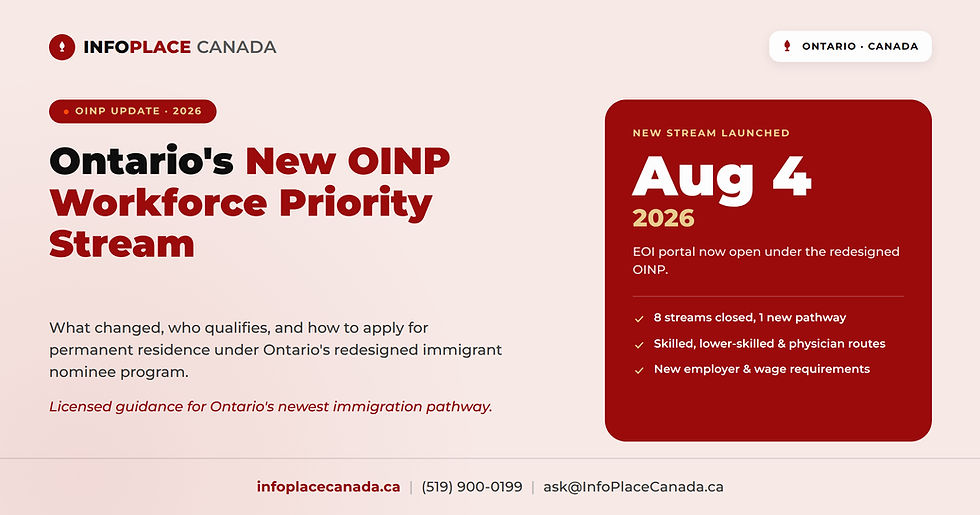
Ontario just relaunched its entire economic immigration program. On August 4, 2026, the province opened applications for the new Ontario Workforce Priority stream, replacing eight separate Ontario Immigrant Nominee Program (OINP) streams with one consolidated pathway to permanent residence.
If you're a skilled worker with a job offer in Ontario, an employer trying to sponsor talent, or an international graduate whose plans just got upended, this is the program you need to understand right now. Below, we break down exactly what changed, who qualifies under the new rules, and how to move on it before deadlines start working against you.
InfoPlace Canada has guided employers and foreign workers through the OINP for years, and our licensed team is already registering clients under the new Workforce Priority stream. If you want to know exactly where you stand, book a consultation before you or your employer submits anything.
What changed, and when
Ontario's redesign rolled out in stages over the summer of 2026:
• May 30, 2026: The province filed regulatory amendments to Ontario Regulation 421/17, laying the legal groundwork for the redesign.
• June 25, 2026: The OINP's Expression of Interest system closed, and eight existing streams were officially discontinued. Any EOI profiles that hadn't already received an invitation to apply were withdrawn.
• August 4, 2026: The EOI portal reopened under the new Ontario Workforce Priority stream.
Ontario has said this is only Phase 1 of a broader, two-phase redesign, with further changes to eligibility, nomination allocation, and temporary foreign worker policy expected later in 2026 and beyond. We're tracking this closely for our clients so they're never caught off guard by Phase 2.
The eight streams that closed
If you were planning to apply under any of the following, that door is now closed and your path runs through the new Workforce Priority stream instead:
• Employer Job Offer: Foreign Worker
• Employer Job Offer: In-Demand Skills
• Employer Job Offer: International Student
• Master's Graduate
• PhD Graduate
• Express Entry Human Capital Priorities
• Express Entry French-Speaking Skilled Worker
• Express Entry Skilled Trades
If you already had an active application submitted before the cut-off, those files continue to be assessed under the rules that applied at the time you filed. Everyone else now applies through the Workforce Priority stream, under a materially different set of rules than the streams they may have been planning around.
Meet the Ontario (OINP) Workforce Priority stream
The new stream folds skilled and lower-skilled job offer pathways, plus a dedicated route for physicians, into one framework built around TEER levels (the federal system that groups occupations by Training, Education, Experience, and Responsibilities). There are three pathways.
Pathway 1: TEER 0 to 3 (skilled workers)
This covers professional, technical, and skilled occupations. To qualify, you generally need:
• A full-time, permanent job offer in Ontario in a TEER 0, 1, 2, or 3 occupation.
• Work experience: Six months of consecutive full-time experience with the job offer employer in the last 12 months, or three months if you're a recent Ontario graduate (a diploma or degree requiring at least two years of full-time study, completed within the last three years), or two years of cumulative full-time experience in the same occupation within the last five years.
Transport truck drivers and bus drivers must meet the six-month requirement regardless of graduate status or licensing.
• Language: Canadian Language Benchmark (CLB) 6 across all four abilities for most occupations, or CLB 5 for a defined list of skilled trades. Recent Ontario graduates are exempt from language testing.
• Education: A minimum one-year post-secondary credential from an eligible Canadian institution, or the equivalent assessed through an Educational Credential Assessment. Skilled trades occupations can qualify with a Canadian high school diploma, and a valid mandatory licence can substitute where the occupation legally requires one.
TEER 0 to 3 nominees can also be nominated through Express Entry, adding 600 Comprehensive Ranking System points and 60 days to submit the permanent residence application, on top of Ontario's own nomination.
This pathway rewards a clean, well-documented file. Language scores, employer letters, and ECA reports all get scrutinized, and our team reviews every piece before it goes in.
Pathway 2: TEER 4 to 5 (lower-skilled workers)
This is where the redesign expanded access. Previously, lower-skilled job offer streams were limited to a closed list of designated occupations. That list is gone, any TEER 4 or 5 occupation can now qualify, provided:
• Work experience: Nine months of cumulative full-time experience with the job offer employer within the last two years.
• Language: CLB 4 or higher across all four abilities (recent Ontario graduates are exempt).
• Education: A Canadian secondary school diploma or the equivalent.
This is genuinely good news for employers in sectors like hospitality, food processing, warehousing, and personal support work who previously couldn't sponsor through the OINP at all. If that's you, it's worth a conversation now.
Pathway 3: Self-employed Physicians
Physicians are the one group who don't need a job offer at all. To qualify, you need valid registration in good standing with the College of Physicians and Surgeons of Ontario and eligibility to bill through the Ontario Health Insurance Plan (OHIP).
What employers need to know
The redesign tightened the rules on the employer side too. To make a valid job offer under the Ontario Workforce Priority stream, an employer generally needs to have:
• Been actively operating in Ontario for at least three years.
• A physical business premises in the province.
• No outstanding orders under the Employment Standards Act or the Occupational Health and Safety Act.
• Met the applicable gross annual revenue thresholds over the last two fiscal years, tiered by location (roughly $1,000,000 in the Greater Toronto Area, $500,000 in other census metropolitan areas, and $250,000 in rural and northern communities, with more flexible thresholds for smaller rural census divisions).
• Employed the required minimum number of Canadian citizens or permanent residents, which also varies by location.
The job offer itself has to be full-time and permanent, genuinely necessary to the employer's operations, and free of any active labour dispute. Employers who previously registered under one of the eight closed streams don't need to re-register as an employer, but they do need to submit new job offers under the new stream.
We work directly with employers to confirm their business meets these thresholds and to build a compliant job offer file before it's submitted, so a technicality doesn't cost a hire.
How the application process works
The redesign introduced a tighter, more time-sensitive sequence:
1. Employer submits a job offer through the Employer Portal, generating a job offer ID.
2. Applicant registers an Expression of Interest within 30 calendar days of the employer's submission.
3. If invited, the employer has 14 calendar days and the applicant has 17 calendar days to submit the full application, and the applicant cannot submit before the employer does.
4. If nominated, the applicant then has six months to apply to Immigration, Refugees and Citizenship Canada (IRCC) for permanent residence.
Ontario also shortened the response window for administrative monetary penalties from 60 to 30 days, so employers should be paying close attention to ongoing compliance, not just the initial application.
Miss one of these windows and you're often starting over. This isn't a program you want to navigate on your own timeline.
What this means if your plans just changed
A lot of people were mid-strategy when this redesign hit. If you were counting on the Master's Graduate or PhD Graduate stream, the Express Entry French-Speaking Skilled Worker stream, or the Express Entry Skilled Trades stream, that specific route no longer exists, and you'll need to be reassessed against the Workforce Priority stream's requirements instead. International students in particular should note the new rules generally expect a demonstrated period of employment with the job offer employer, a real shift from streams that previously let a strong academic profile carry more weight.
On the other side, the removal of the closed occupation list for TEER 4 and 5 roles opens the door to a wider range of employers and occupations than before, and physicians now have a direct route into the program without needing a job offer at all.
Frequently asked questions
What is the Ontario Workforce Priority stream? It's the new OINP pathway, launched August 4, 2026, that replaced eight previous streams. It covers skilled workers (TEER 0 to 3), lower-skilled workers (TEER 4 to 5), and self-employed physicians, each with its own eligibility requirements.
Do I need a job offer to qualify? Yes, unless you're a self-employed physician. Both the TEER 0 to 3 and TEER 4 to 5 pathways require a full-time, permanent job offer from an eligible Ontario employer.
What happened to streams like Express Entry Human Capital Priorities or the Master's and PhD Graduate streams? They were closed as of June 25, 2026, and are no longer accepting applications. Anyone who was planning around one of those streams now needs to qualify under the Workforce Priority stream instead.
How long do I have to apply once my employer submits a job offer? You need to register your Expression of Interest within 30 calendar days of your employer's job offer submission. If invited to apply, your employer has 14 days and you have 17 days to file the full application.
Can international students still qualify? Yes, but the rules changed. Recent Ontario graduates get reduced work experience requirements and, in most cases, a language testing exemption, but a period of employment with the job offer employer is now generally required.
Is there a minimum wage requirement? Wage level is factored into eligibility and scoring, and it varies by pathway and occupation. This is exactly the kind of detail worth confirming for your specific job offer before you file.
How InfoPlace Canada can help
The OINP redesign means new opportunities and new ways to get disqualified on a technicality, sometimes in the same application. Our licensed team has continually worked with clients across the OINP's various streams, and we're already filing under the new Workforce Priority stream for both employers and applicants.
Here's how we can help you move on this:
• Eligibility assessment: We review your work experience, language scores, and education against the exact pathway you're applying under, before you register anything.
• Employer readiness review: We confirm your business meets the revenue, staffing, and compliance thresholds and help you build a clean job offer file.
• EOI and application filing: We manage your Expression of Interest registration and full application within the new, tighter deadlines, so nothing slips.
• Post-nomination support: We carry your file through to your permanent residence application with IRCC.
If you have questions about where you stand under the new rules, or you just want a straight answer instead of guessing, reach out and let's talk through it.
Phone: (519) 900-0199
Email: ask@InfoPlaceCanada.ca
Website: infoplacecanada.ca
This article is general information, not legal advice. Every immigration file is different, so contact our licensed team directly for advice tailored to your specific situation before you apply.


